An employee shuttle service gets your people to and from work, a site or an event on a planned timetable, without each person finding their own way. For a Melbourne business, the simplest way to run one is with pre-booked, chauffeur-driven minibuses and coaches: professional drivers, door-to-door pickups, flexible stops and clear pricing agreed before the first run. At Lux Mini Bus we offer corporate transport built around exactly those bookings, so you plan the route once and your staff simply turn up.
This guide explains what a staff shuttle is, how to design one that people actually use, what to check on safety and accessibility, how to judge whether it works, and what drives the cost.
TL;DR
- An employee shuttle is scheduled transport between fixed points, such as a station and a worksite, planned around your shifts rather than a single one-off trip.
- Start with data: where staff live, when they start and finish, and where public transport falls short.
- Check seatbelts, driver professionalism and access needs before the first run, not after.
- Measure punctuality, cancellations, complaints and satisfaction monthly, and adjust the route.
- Lux Mini Bus offers one-way, return, multi-stop, hourly, half-day and full-day chauffeured bookings across Melbourne, with clear pricing.
Table of Contents
- What an employee shuttle service actually is
- Why a chauffeured minibus suits staff transport
- Planning the route: start with where your people are
- Safety and accessibility checks before the first run
- How to tell whether the shuttle is working
- What affects the price of staff transport
- Beyond the daily commute: when teams need a shuttle
- Book staff transport in Melbourne
- FAQ
- Sources
What an employee shuttle service actually is
A staff shuttle is a private bus service a business puts on for its employees. Transport Scotland's toolkit describes it as a service used where public transport is thin, outside peak times, or to make commuting greener. The same page lists benefits employers look for: easier recruitment and retention, less pressure on on-site parking, time and money savings for staff, and better attendance.
The defining feature is repetition. One US provider describes an employee shuttle as recurring, scheduled transport between fixed points on a set route, such as a train station and a campus, run to a regular daily or weekly pattern. That separates it from a single charter for one event. A shuttle needs route planning, a vehicle sized to the load, driver scheduling and someone watching performance.
In practice, Melbourne employers use shuttles in a handful of ways:
- Station connector: a minibus meeting trains at the nearest station and running to an office park or industrial estate.
- Car park loop: moving staff between an overflow car park and the building.
- Shift change run: early-morning or late-night trips when trains and trams are infrequent or have stopped.
- Event and offsite transport: moving a team to a conference, training day, site visit or celebration.
The last one is where chauffeured hire is most natural, and the first three follow the same planning logic.
Why a chauffeured minibus suits staff transport
Owning and running your own vehicles means drivers, insurance, maintenance and rostering, all of which pull your managers away from their real work. Hiring a chauffeured vehicle puts the driving, the vehicle and the punctuality in one booking.
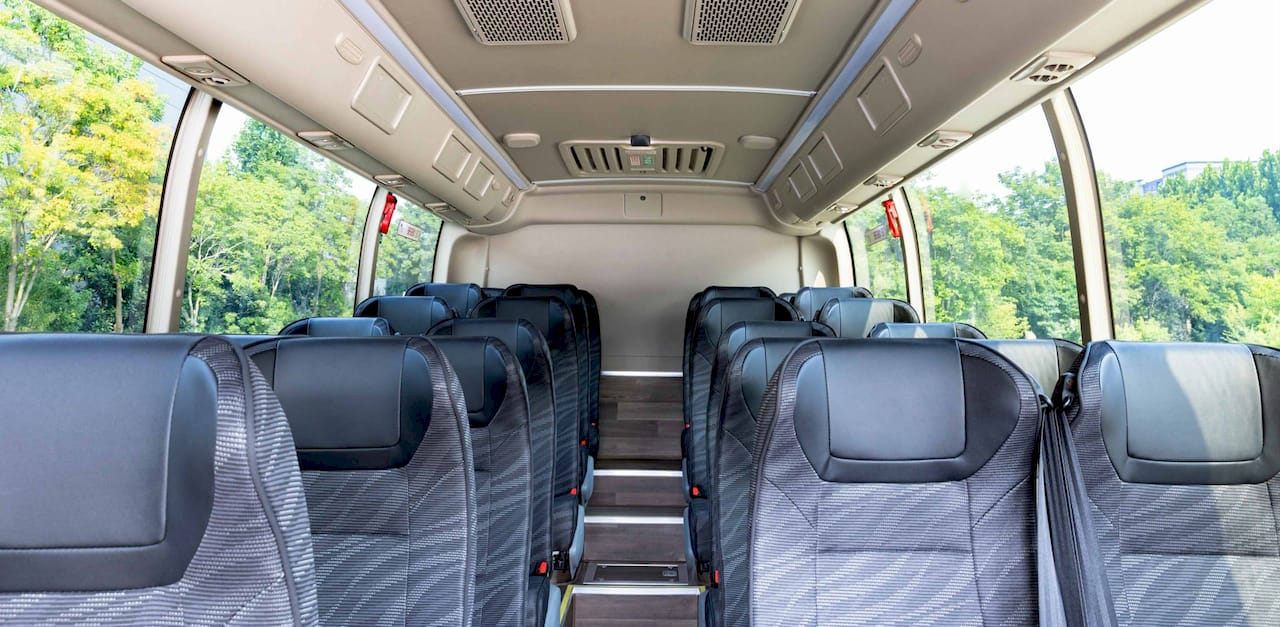
With Lux Mini Bus, the booking can be one-way, return, multi-stop, hourly, half-day or full-day, with door-to-door pickup. That range matters for staff transport because the pattern of a team's day rarely fits one shape. A morning drop-off to a client site and an evening return is a return booking. A group collected from three suburbs and delivered to one head office is a multi-stop run. A full-day hire covers a training day with a lunch break in the middle. Our drivers are professional and local, so they know the roads, the pickup points and the traffic on the way in.
The point is peace of mind: your people arrive on time, comfortable and ready, and you have one clear price and one contact rather than a dozen individual arrangements. You can see our corporate service on our corporate minibus hire page.
Planning the route: start with where your people are
The most common reason shuttles fail is that they are designed from the office outwards, not from the staff inwards. The NSW Government's travel plan toolkit suggests a better order: identify your needs, then assess the current situation through a site assessment, a review of your travel policy, staff surveys or focus groups, Census journey-to-work data, and mapping where employees live against the transport available to them. It also recommends senior-level support and a clear decision-making process.
It is a NSW document, but the method applies to any Australian workplace, including Melbourne. Here is a practical version.
- Map home suburbs. A simple spreadsheet of postcodes, with no names, shows clusters. If twelve staff live within a few kilometres of the same station, that is your first pickup point.
- List shift times. A shuttle that meets a 9 am start does nothing for the 6 am crew. Note start and finish times, and when public transport is infrequent around them.
- Survey, briefly. Ask how people travel now, how long it takes, and what would make them use a shuttle. Five questions is enough.
- Choose fixed points. Keep stops few. Every extra stop adds minutes for everyone on board.
- Size the vehicle. Match the vehicle to the number of riders on the busiest run. A luxury sedan, minibus or coach each suits a different headcount, and we can advise on the right fit when you request a quote.
- Decide the booking pattern. Hourly, half-day or full-day hire suits irregular needs. For a set run, a return or multi-stop booking gives you certainty on time and price.
A worked example
Imagine a Melbourne logistics office with 14 staff who start at 7 am. A survey shows nine of them live along one train line and arrive at the station by 6.30 am. A one-way booking from the station to the office, plus a return in the afternoon, covers those nine with a single minibus. The other five keep driving. The employer now has a measurable pilot: nine people, two runs a day, one vehicle. The numbers here are illustrative, not a benchmark, but the shape of the exercise is what counts: start small, prove it, then extend.
Lessons from a real Australian shuttle
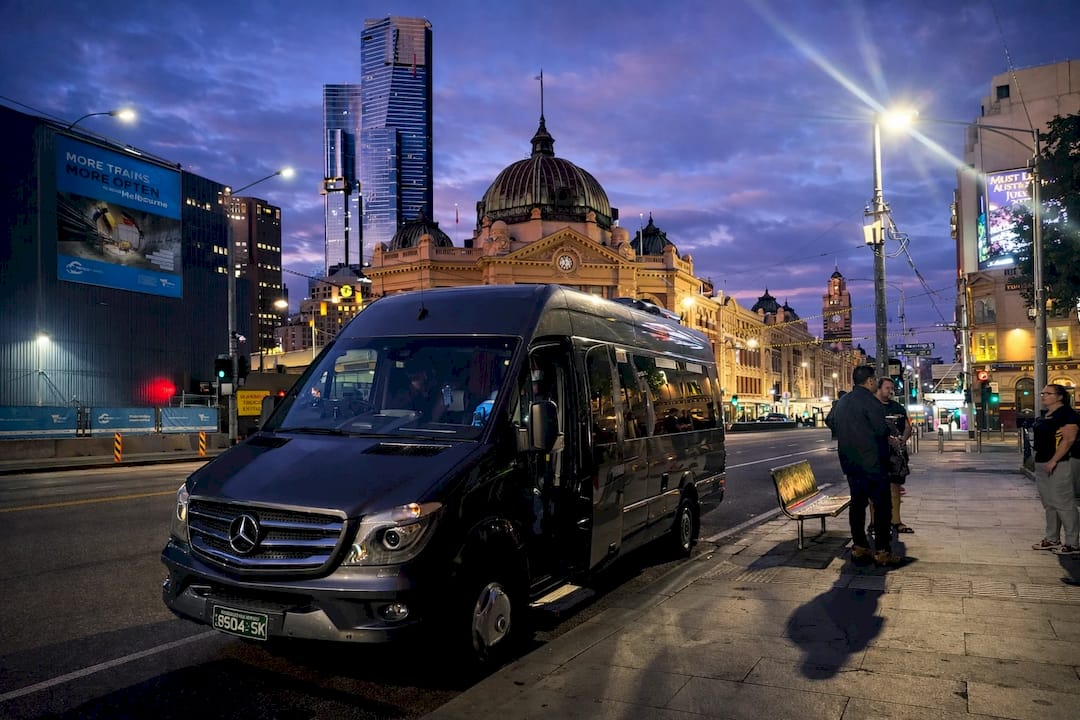
A 2017 paper to the Australasian Transport Research Forum on the Optus Centre in Sydney describes a long-running employee bus. It reports that the free, exclusive rail-transfer bus carried around 1,700 employees a day. On the busiest routes it ran turn-up-and-go services at peak times, with timetabled off-peak runs meeting key train departures. After a new rail line opened it continued, with staff contributing to the cost of afternoon journeys.
Two lessons carry over. First, tie the timetable to the trains your staff really catch. Second, a shuttle can evolve as the transport network around it changes, so plan to review it.
Safety and accessibility checks before the first run
A shuttle is only reliable if people feel safe in it. Before launch, work through these points.
- Seatbelts. In Australia everyone in a vehicle must wear an approved seatbelt, child restraint or booster seat, with special rules for people with disability or medical conditions, as set out in the NDIS Commission's Safe Transportation Practice Guide. Brief riders on the rule at the start.
- Access needs. The NSW toolkit advises employers to think about access for people with mobility impairments or who feel more vulnerable when travelling. Ask in your survey whether anyone needs step-free boarding or extra time, and tell us when you book so the trip is arranged around it.
- Late-night travel. Employee travel safety and security is one of the internal reasons the same toolkit gives for a workplace travel plan. For late finishes, a door-to-door pickup means nobody waits alone at a stop.
- Driver professionalism. Your staff will see the driver every day, so punctuality, courtesy and local knowledge matter as much as the vehicle.
- Clear communication. Share the pickup point, time and a contact number with every rider in writing before day one.
If an employee has a specific medical condition or disability, speak with them directly, and with their health professional or your HR adviser where appropriate, about what they need to travel comfortably.
How to tell whether the shuttle is working
A shuttle that runs is not the same as a shuttle that works. Public transport operators in NSW are held to a clear set of measures. Transport for NSW's bus contract schedule tracks customer complaints (under 22 per 100,000 boardings), on-time running at first, middle and last stops, cancelled or incomplete trips, and customer satisfaction, reported monthly with commentary on trends. Those are large-network figures, so use the categories rather than the number. For a staff shuttle, a monthly one-page review of the same four things is plenty:
| Measure | What to record | Question it answers |
|---|---|---|
| Punctuality | Arrival against the scheduled time at each stop | Do staff reach work on time? |
| Cancelled or short runs | Count per month | Is the service dependable? |
| Complaints and comments | Short list of themes | What irritates riders? |
| Satisfaction | Two-question pulse survey | Would they keep using it? |
Researchers Wake, Thom and Cummings argue that judging a workplace travel measure takes more than before-and-after surveys. Their four-step evaluation framework looks at the quality of the plan, how well actions were carried out, organisational commitment, and outcomes, using several measures together such as car park counts and public transport patronage alongside surveys. For you, that means counting empty car park bays and late arrivals as well as asking opinions. If your wider goal is a lower-impact workplace, our note on workplace sustainability measures is one example of tracking results against a target.
When the figures show a pattern, such as one stop always running late, change the route or the pickup time. Because our bookings are flexible and customised, adjusting an itinerary is a conversation about the next booking, not a renegotiation of a rigid contract.
What affects the price of staff transport
Published prices vary by operator and we do not list a fixed rate here, so treat any figure you see elsewhere as specific to that job. The factors that move the price of chauffeured group transport are consistent, and knowing them lets you compare quotes sensibly:
- Hire pattern: a one-way transfer, a return, an hourly booking and a full day are priced differently.
- Vehicle size: sedan, minivan, minibus or coach.
- Distance and number of stops: a multi-stop run takes longer than a direct one.
- Time of day: early starts, late finishes and weekends can differ from standard hours.
- Waiting time: a driver who waits for a shift to finish is a different booking from a drop-off.
- Frequency: a regular run planned in advance gives both sides certainty.
Our approach is clear and honest pricing. Give us the pickup points, times, headcount and how often you need the run, and we quote the job so you know the cost before you commit. For many teams, one shared vehicle compares well with the combined cost of parking, fuel and rideshare fares, but the only reliable comparison is your own numbers against a written quote.
Beyond the daily commute: when teams need a shuttle
Not every employee shuttle is a commute. Melbourne businesses often need the same planning for:
- Airport transfers for visiting executives or staff flying interstate. We cover Melbourne Airport minibus transfers on our corporate travel page.
- Conferences, offsites and training days, where the whole team arrives together and nobody hunts for parking.
- Team-building and thank-you days, including a winery tour with a chauffeur so everyone can relax.
- Larger groups, where premium bus hire moves everyone in one vehicle.
Arriving together makes the right impression before the meeting begins, and it keeps the day on schedule.
Our view: reliability is the whole product
A shuttle is judged in the first five minutes of every trip. If the vehicle is there when it was promised and the driver knows where to go, staff stop thinking about the commute. If it is late once, they go back to their own cars.
That is why we focus on professional drivers, door-to-door pickups, flexible itineraries and clear pricing. We don't just move people, we take care of them. A good brief makes that easy: tell us the stops, the times and any access needs, and we plan the trip around your team instead of asking your team to fit around a fixed timetable.
Start with one run and measure it. If it works for nine people, it will work for ninety.
Emrah
Book staff transport in Melbourne
If you are planning staff transport, a team offsite or a regular run to a worksite, our corporate service is built for it: chauffeured minibuses and coaches, professional drivers, door-to-door pickup, and bookings that can be one-way, return, multi-stop, hourly, half-day or full-day. Send us your stops, times and headcount through our corporate minibus hire page and we will come back with a clear quote.

You can also browse everything we offer on our Melbourne minibus services page.
FAQ
What is the difference between an employee shuttle service and a one-off charter?
A shuttle is recurring transport between fixed points on a set schedule, while a charter is a single booking for one trip. Shuttles need route planning, driver scheduling and regular review. For one-off events, a single booking such as a return or full-day hire is simpler.
How many staff do I need before a shuttle makes sense?
There is no fixed number. Start by mapping where staff live and when they start. If a cluster of people shares a station or suburb and a shift time, a pilot run for that group is worth testing, and the vehicle can be sized to match.
Can a chauffeured minibus pick staff up from their homes?
Yes. We offer door-to-door pickup, and multi-stop bookings let one vehicle collect several people before heading to the destination. Share the addresses and times when you request a quote.
How do I know if the shuttle is worth the cost?
Track punctuality, cancelled runs, complaints and rider satisfaction monthly, and compare with car park counts and late arrivals before and after. Put the figures next to a written quote to see the whole picture.
Sources
- Staff Shuttle Bus, Transport Scotland
- Employee Shuttle and Corporate Transportation Services, Metropolitan Shuttle
- Preparing your organisation's travel plan, NSW Government
- Reflecting on ten years of the Optus Centre employee bus, Australasian Transport Research Forum 2017
- Safe Transportation Practice Guide, NDIS Quality and Safeguards Commission
- Schedule 4, Key Performance Indicators, Transport for NSW
- Evaluating workplace travel plans, Australasian Transport Research Forum 2010